Snapmaker 2.0 Modular A250T Reviews: See Why 0 Shoppers Rated It 0 Stars!
We gathered 0 reviews of the Snapmaker 2.0 Modular A250T 3d printer to answer one thing: Does it live up to its 0/5 score?
 Supermod
 Moderator
 Recaptor
Snapmaker 2.0 Modular A250T: A Versatile Desktop Fabricator for All Skill Levels
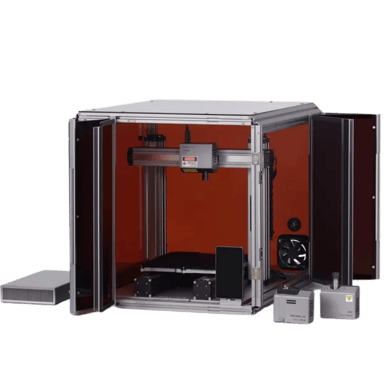
The Snapmaker 2.0 Modular A250T stands out as a multi-functional 3D printer designed for a wide range of users, from beginners to professionals. Built as a versatile FDM/FFF printer, its strength lies in being a triple-threat desktop fabricator, supporting 3D printing, laser engraving, and CNC carving. With a release year of 2021 and crafted in China, this model combines modularity with a sturdy kit assembly requiring user setup, appealing to creators aiming for hands-on customization.
The combination of broad application scopes, such as prototyping, engineering, and miniatures, and an inclusive target audience from beginners to professionals makes it a notable contender in the desktop fabrication space. On paper, the A250T's modular design and upgrade paths hint strongly at both longevity and adaptability in various maker environments.
Detailed Specs & Features: Precision and Modularity Engineered
According to specs, the build volume of the Snapmaker 2.0 is approximately 824.53 cubic centimeters, supported by build dimensions roughly 9.1 by 9.8 by 9.3 inches for width, depth, and height, respectively. This offers a comfortable workspace for medium-sized projects typical for desktop users. The device operates within a standard range of 41 to 95°F and supports various filament types, mainly PLA, at the standard 1.75mm diameter. Its max extruder temperature of 527°F and a heated bed peaking at 212°F enable printing with a respectable range of materials, albeit limited to single-extruder setups, which restricts multi-material or dual extrusion professional workflows.
The touch-enabled 5-inch display with a crisp 1280x720p resolution provides intuitive control, further simplifying the user interface. When it comes to power, the unit runs on an external 100-240 Volt power supply with a consumption of 320 watts, augmented by an energy-saving mode that helps reduce idle power draw. Its direct drive extruder, paired with layer resolutions from 50 to 300 microns, offers a balanced range for both detailed and fast prints. Furthermore, the modular toolhead system accommodates laser and CNC upgrades, enhancing the printer's utility beyond additive manufacturing.
Design & Build
Build quality feels robust considering its 34.39 lbs weight and footprint (16 x 16.7 x 19.3 inches), which fits comfortably on most desktops. The Cartesian frame paired with an open enclosure design supports easy access and visual monitoring, though it sacrifices some environmental controls typically advantageous for temperature-sensitive prints.The inclusion of auto bed leveling alongside manual options improves print setup ease, ensuring better first-layer accuracy. Removable PEI magnetic build plates with textured surfaces ensure excellent print adhesion and ease of part removal, enhancing user convenience. While lacking chamber lighting and a built-in camera, the hardware's focus remains on print precision and modular flexibility rather than full ambient control.
Performance
Performance-wise, the printer can achieve a maximum print speed of 100 mm/s, which is competitive for desktop FDM machines. Print accuracy rated at 50 microns speaks to its potential for detailed prototyping and miniature work, which aligns with its targeted use cases. The device supports print recovery and has a filament runout sensor, both reducing failed prints and downtime, which benefits new and advanced users alike. Operating noise levels pegged at 50 dB suggest a moderate noise environment; something to consider for quiet workspaces. Despite missing spaghetti-fault detection or vibration compensation, the linear rails and belt motion system promise smooth motion fidelity.Camera / Display / Audio Quality
While a built-in camera is absent, this keeps costs and complexity down. The 5-inch touchscreen is vibrant with a 1280x720 pixel resolution, providing responsive control and easy parameter adjustments. Audio isn't specified beyond operational noise, but the system's power electronics and fans ensure steady performance without disruptive sounds. This screen real estate, coupled with snap-in upgrade options for CNC and laser, creates a focused but adaptable user interface, optimized for workflow continuity.Extra Features
Additional perks include remote firmware and monitoring capabilities accessible over USB and Wi-Fi, enhancing usability for remote management. Though the printer doesn't rely on proprietary software, it supports popular slicers like Snapmaker Luban, Cura, Simplify3D, and Slic3r, ensuring broad compatibility with existing user toolchains. Safety certifications such as CE, FCC, and RoHS guarantee adherence to international electrical and environmental standards. Overheat protection, emergency stop buttons, and auto-shutdown on error provide dependable fail-safes, reinforcing user trust and operational safety.Pros & Cons
Pros
- Modular design with multi-tool upgrade path (3D, laser, CNC)
- Auto bed leveling and filament runout sensor enhance print reliability
- Wide filament compatibility with standard 1.75mm PLA support
- Support for major slicers without proprietary software requirements
Cons
- Single extruder limits multi-material or color printing opportunities
- An open frame design may affect print quality in drafts or temperature fluctuations
- Lacks some advanced sensors, like filament jam or vibration compensation
Price & Value For Money
Priced at $1149 at MatterHackers, the Snapmaker 2.0 Modular A250T offers solid value given its extensive feature set and software compatibility. Given its one-year warranty period and modular upgrade pathways, this investment feels justified for makers seeking growth and adaptability in their equipment. While professional users needing multi-extruder setups may find the price less compelling, hobbyists and educators will appreciate the balance of accessibility, functionality, and support. The external power supply design and energy-saving mode further contribute to cost-efficiency over time.Quick Take
In short, the Snapmaker 2.0 Modular A250T brings together modularity and ease of use with a respectable build volume and reliable print accuracy. If we look at the numbers alone, it's a capable machine that addresses both educational and professional workflows, especially when factoring in its upgrade potential to laser and CNC. This makes it a strong choice for users wanting a future-proof all-in-one fabricator.Closing Recommendation
The Snapmaker 2.0 Modular A250T may be ideal for users seeking a multi-disciplinary machine that grows with their skills, from 3D printing novices to professional makers incorporating laser and CNC tooling. It appears to perform best in controlled environments where the open frame is less a liability than a convenience, helping users achieve precision and versatility without exorbitant complexity. Those prioritizing dual extrusion or enclosed printing environments may want to explore alternatives, but its modular core and reliable engineering present clear strengths for a broad maker audience.Verdict
Rating: Based on the specifications and overall feature set, we believe Snapmaker 2.0 Modular A250T deserves 4.2 out of 5.
- Winner Feature => Exceptional modular system enabling 3D printing, laser engraving, and CNC machining in one machine.
- Needs Improvement => Single extruder limits multi-material printing, and the open frame design impacts optimal environmental control.
Reviews 0
The good, the bad, and the brutally honest.Average Rating


More 3D Printers 453
Unlock more awesome finds.